K-Tip Extensions for Thin Hair: 2026 Guide to Volume
What if you could double your hair's density without the constant fear of a visible bond or heavy tension pulling at your roots? For many with fine strands, the dream of fuller hair often feels out of reach. You worry about bulky attachments showing through or traditional methods causing more breakage. Using k-tip extensions for thin hair changes the narrative, offering a weightless solution that prioritizes your hair's health.
We understand that your hair needs a gentle touch and a precise finish. This 2026 guide explains why keratin bonds are the ultimate choice for a natural, damage-free transformation. These lightweight, individual strands move exactly like your own hair. They offer a level of discretion that older methods simply cannot match. You'll discover how micro-bonds provide 360-degree movement and a lifespan of up to five months. We'll break down everything from the sensory experience of raw hair to the styling freedom of high ponytails. Get ready to reclaim your confidence with a look that is as effortless as it is sophisticated.
Key Takeaways
- Learn why keratin-based protein bonds are the safest choice for thin strands, mimicking your hair's natural structure for a flexible and seamless hold.
- Discover the micro-bond strategy used to customize k-tip extensions for thin hair, ensuring attachments remain completely invisible even in high-visibility areas.
- Understand the critical weight-matching rules that prevent tension and protect your natural hair from damage or traction alopecia.
- Master essential maintenance techniques, from using loop brushes to specific washing protocols, to keep your volume looking flawless for up to five months.
- Explore how 100% raw human hair and cuticle alignment create a lightweight, tangle-free blend that moves naturally with your own hair.
Understanding K-Tip Extensions for Thin Hair
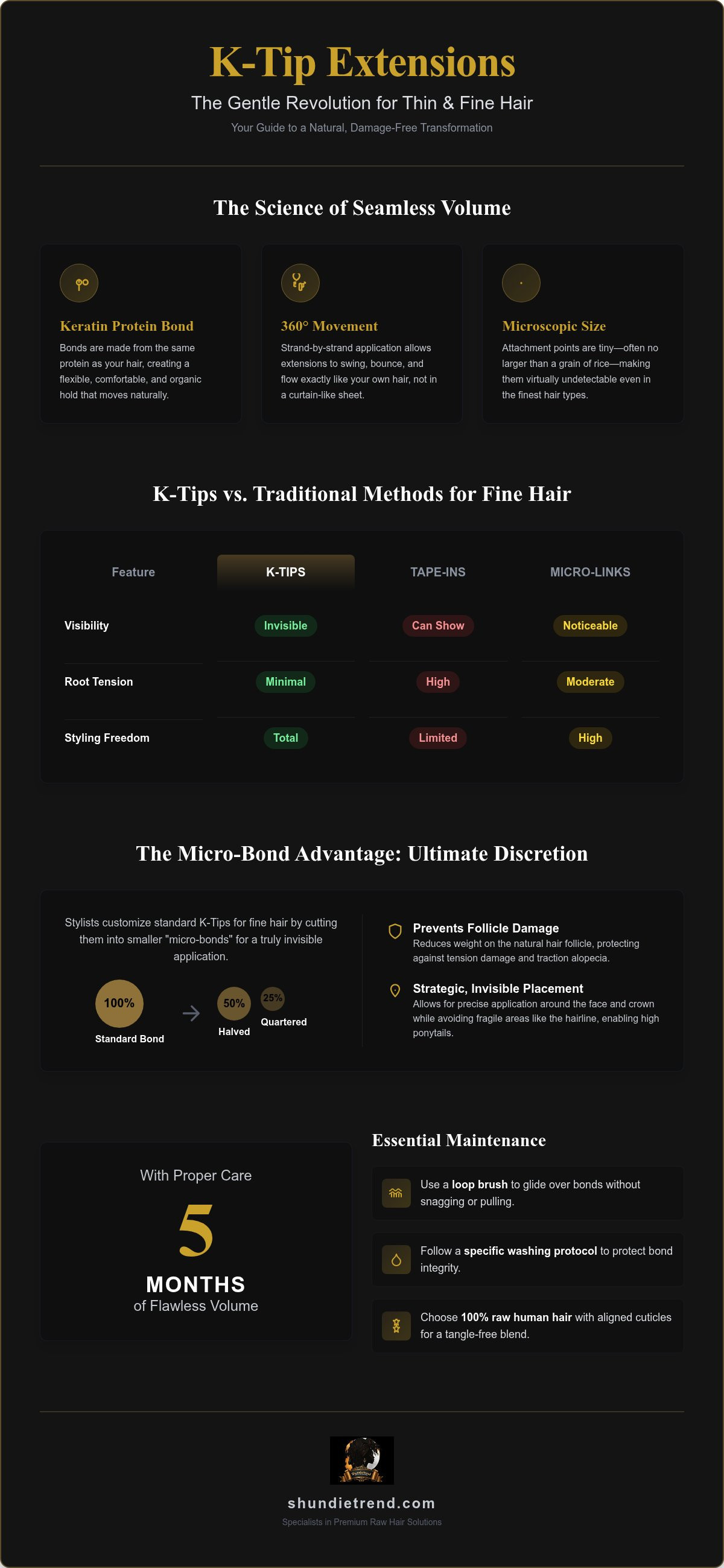
K-tip extensions, often called keratin tips, are individual hair strands pre-bonded with a specialized protein. Unlike heavy wefts or wide tapes, these extensions are fused to your natural hair in small, precise sections. Choosing k-tip extensions for thin hair provides a level of customization that other methods simply can't match. Each attachment point is tiny, often no larger than a grain of rice, which makes them virtually undetectable even in the finest hair types.
The "K" in K-tips stands for keratin. To appreciate why this is the gold standard for thin hair, it helps to understand what keratin is and how it functions as a structural protein. Because your natural hair is primarily composed of this same protein, the bond mimics your hair's organic structure. This results in a flexible, comfortable hold that feels like a natural extension of your scalp rather than a rigid, artificial attachment.
Movement is where this method truly shines. K-tips offer 360-degree movement, meaning they swing, bounce, and flow exactly like your own hair. They don't move in a "curtain" or "sheet" like traditional wefts. This individual attachment also solves the problem of weight distribution. Heavy wefts can create a constant dragging sensation that stresses the roots. K-tips spread the weight evenly across the head, ensuring that no single natural strand is overwhelmed by the extension.
K-Tips vs. Traditional Extension Methods
Tape-ins are often too wide for low-density hair, as the flat corners can peek through thin sections during movement. K-tips outperform these because they are customizable. A skilled stylist can cut a single bond into halves or quarters for extreme discretion. Unlike micro-links, which use metal beads that can be heavy or abrasive, K-tips rely on a soft protein bond. This strand-by-strand application method is essential for creating high-density results that look and feel authentic.
The Science of Keratin Bonding
The application process uses a heat-fusion tool to soften the keratin tip, creating a water-tight, secure seal around your natural hair. It's a breathable bond that doesn't trap moisture or cause damage. A unique feature of this science is how the bond behaves; it actually expands and contracts with your hair when it gets wet. This prevents the hair from snapping or becoming brittle inside the bond. When you select raw human hair bundles that are pre-tipped, you get a lightweight, high-performance finish that integrates flawlessly into your daily routine.
The Micro-Bond Advantage: Why They Disappear in Fine Strands
The secret to a flawless finish with k-tip extensions for thin hair lies in the art of customization. Standard bonds are often too bulky for fine strands. Professional stylists overcome this by "quartering" or "halving" the keratin tips before application. This creates a bond so small it becomes invisible even when the wind blows. By reducing the size of the attachment, you also reduce the weight on the natural follicle. This precision prevents the common dangers of hair extensions like tension-induced thinning or traction alopecia.
Strategic placement is the next step in your volume journey. We focus on the "money piece" around the face and the crown area. These are the spots where volume makes the most impact on your silhouette. Instead of a uniform application, density matching ensures we only add hair where your natural roots can support it. We also recommend using three to four different shades. This multi-tonal approach creates depth and dimension. Color blending isn't just about matching; it's about architecture. By mixing cool and warm tones, we create a visual density that makes thin hair look twice as thick. It mimics the natural color variations of healthy hair, ensuring the extensions melt into your look.
Invisible Placement Techniques
Traditional methods often rely on a "sandwich" approach that can feel heavy and obvious. Individual strand placement offers a far more discreet result. This technique allows for total styling freedom. You can wear high ponytails or sleek top knots without worrying about exposed hardware. Mapping the scalp is essential for success. We avoid "danger zones" like the very edge of the hairline or the nape where hair is naturally at its thinnest. This careful mapping protects your hair health while maximizing your style options. If you are looking for the highest quality hair for this process, you can explore premium raw hair options that blend seamlessly with your natural texture.
The "Micro-Tip" Revolution
The 2026 trend focuses on the "micro-tip" for ultra-fine hairlines. These are even smaller than standard k-tip extensions for thin hair. They are designed specifically for the most delicate areas of the head where traditional bonds would show. Smaller bonds mean less tension on individual strands, which is vital for long-term hair health. The result is a seamless melt. It looks as if the new volume is growing directly from your scalp. This precision creates a finish that is polished, professional, and entirely undetectable. It provides the confidence of full hair without the compromise of visibility.
Safety First: Preventing Tension and Damage on Thin Hair
Safety is the foundation of any hair transformation. When you choose k-tip extensions for thin hair, the "Golden Rule" of weight distribution is your best defense against damage. An extension should never be heavier than the natural hair holding it. This 1:1 ratio ensures your follicles remain healthy and unstressed. Professional sectioning is the only way to manage this balance. It prevents the uneven tension that leads to traction alopecia. By distributing the weight precisely, your hair remains strong, vibrant, and full.
There is a common myth on platforms like Reddit that keratin bonds are a form of "glue" that will melt your hair. This is simply not true. Keratin is a natural protein. The bonds are designed to mimic your hair's organic structure. They are flexible. They are breathable. They are gentle. When applied with a professional low-heat tool, the keratin softens just enough to wrap around your hair. It does not fuse with the inner cortex. It creates a protective, water-tight seal that is safe for even the most delicate strands.
For those with fine hair, a four-week check-up is a vital part of the process. This isn't a full maintenance appointment. It's a quick professional audit. Your stylist will check for any twisting or matting at the root. This proactive step ensures your k-tip extensions for thin hair stay perfectly aligned as your natural hair grows. It provides peace of mind and guarantees the longevity of your investment.
Signs of a Healthy Installation
A healthy installation should feel like nothing at all. You shouldn't experience constant pulling, pinching, or itching. If you feel tension when you sleep, the bonds may be too close to the scalp. A visual check is also essential. Bonds must remain invisible even when your hair is in motion. Proper spacing is the secret. It allows for natural scalp airflow and prevents the bonds from clumping together. Smooth. Precise. Effortless.
Safe Removal and Reinstallation
Removal is a scientific process that requires a professional touch. Never attempt at-home removal. Professionals use a specialized alcohol-based solution to break down the keratin bond. This solution turns the solid bond into a soft gel, allowing the extension to slide off without any tugging. During this time, you'll see some hair shedding. Don't worry. Humans naturally lose 50 to 100 strands every day. These strands stay trapped in the bond for months. When the bond is released, those shed hairs come out all at once. This is a natural cycle, not a sign of damage.
Maintenance and Styling for Maximum Longevity
Longevity isn't just about the professional installation; it's about the daily ritual you maintain at home. When wearing k-tip extensions for thin hair, your primary goal is to keep the bonds clean, dry, and separated. A loop brush is your most important tool for this journey. Unlike standard brushes, its looped bristles glide over the keratin bonds without snagging or pulling. This prevents matting at the roots. Brushing three times a day keeps your strands aligned and your scalp healthy. Precision is key. Hold the roots of your hair with one hand while brushing with the other. This simple habit minimizes the tension on your natural follicles. Start at the ends. Work your way up. It's a gentle process that yields high-end results.
Washing requires a strategic and purposeful approach. Focus your shampoo on the scalp. Use gentle, vertical motions to cleanse the skin. Avoid scrubbing the bonds horizontally, as this can cause tangling. Look for sulfate-free formulas that prioritize scalp health without stripping natural oils. A clean scalp provides a stable foundation for the keratin bonds to hold firmly for months. Rinse thoroughly to ensure no product remains trapped near the fusion points. When conditioning, only apply product from the mid-lengths down. Oils and silicones are the enemies of keratin. These ingredients can cause the bond to soften and slip. This leads to premature shedding and a shorter lifespan for your added volume.
The Daily Routine for Thin Hair Extensions
Step 1: Every morning, run your fingers through your hair to separate the bonds. This ensures no individual strands have tangled overnight. It keeps the installation fresh and comfortable. It also allows you to feel the integrity of each bond.
Step 2: Apply a silk mist spray for hair to your mid-lengths. This adds a layer of weightless hydration. It keeps the hair feeling smooth, polished, and manageable throughout the day. It provides that signature sensory experience of luxury hair.
Step 3: Stick to low-heat styling. While K-tips are durable, excessive heat can compromise the keratin seal over time. Always use a heat protectant to maintain the integrity of the bond. This ensures your k-tip extensions for thin hair remain secure for the full three to five months.
Nighttime Protection Strategies
A low braid or loose ponytail is mandatory before you hit the pillow. This prevents the extensions from friction and tangling while you move. It's a non-negotiable step for thin hair safety. Using a satin bonnet for hair protection is the ultimate luxury. Satin reduces friction. It prevents frizz. It keeps the bonds secure. You'll wake up with tangle-free, voluminous hair that's ready for the day. For the best results, explore our professional care collection to keep your hair looking salon-fresh every morning.
Choosing High-Quality K-Tips for a Natural Blend
When selecting k-tip extensions for thin hair, the source of the hair determines the final result. Most brands offer virgin hair, but raw human hair bundles provide a distinct advantage for fine strands. Raw hair is completely unprocessed. It retains its natural strength and elasticity. This makes it significantly more lightweight than hair that has been chemically treated to achieve a specific color or texture. For thin-haired clients, every gram matters. Raw hair allows you to achieve maximum volume without adding unnecessary bulk to your scalp.
Cuticle alignment is the secret to a seamless blend. This means every strand is facing the same direction from root to tip. When cuticles are misaligned, the hair becomes rough and prone to matting. This creates a "puffy" appearance that makes extensions obvious. Precision alignment ensures the hair remains smooth, flat, and reflective. It creates a high-shine finish that integrates effortlessly with your natural luster. Investing in premium hair also offers better long-term value. While the initial cost is higher, the hair remains vibrant and reusable for multiple reinstallations over three to five months.
Texture matching is the final piece of the puzzle. Whether you have straight, body wave, or curly hair, the extension must mimic your natural pattern when air-dried. A perfect match ensures that your k-tip extensions for thin hair are undetectable even without heat styling. Choosing the right wave pattern prevents that tell-tale "shelf" where your natural hair ends and the extensions begin. It creates a cohesive, believable silhouette from root to end.
The Shundietrend Quality Standard
We maintain a rigorous standard for every bond we produce. Our 100% human hair strands offer a sensory-rich finish that feels soft to the touch. Each keratin bond is crafted with precision. They are designed to be small, durable, and discreet. Our hair maintains its luster through dozens of washes. It doesn't become dry or brittle. It stays healthy. It stays beautiful. This commitment to excellence ensures your hair looks as good in month five as it did on day one.
Ready to Transform Your Thin Hair?
Determining your needs is simple. For a volume-only transformation on thin hair, most clients require two to three packs of hair. If you aren't ready for a semi-permanent commitment, consider the benefits of clip-in hair extensions. They allow you to test the added density before moving to a bonded method. When you are ready for a permanent transformation, we are here to guide you. Shop Shundietrend K-Tip Extensions for Thin Hair to begin your journey toward effortless, luxurious volume.
Step Into Your Most Confident Hair Year Yet
You now have the complete blueprint for a seamless hair transformation. By choosing k-tip extensions for thin hair, you prioritize both aesthetic perfection and scalp health. We've explored how micro-bonds disappear into fine strands and why keratin remains the safest choice for long-term wear. Remember that quality is the foundation of every great style. Investing in 100% raw human hair that is cuticle-aligned ensures zero tangling and a natural, high-shine finish. These premium strands move with you, providing 360-degree flexibility and the freedom to style your hair exactly how you want. It's time to stop worrying about visible bonds and start enjoying the density you've always wanted. With secure national US shipping, your journey to effortless, luxurious volume is closer than you think. You deserve a style that enhances your natural beauty without compromise. Upgrade to Premium K-Tip Extensions Today and step into your most confident era yet.
Frequently Asked Questions
Can I get K-tip extensions if my hair is very thin or fine?
Yes, you can absolutely wear these extensions. K-tips are often considered the best choice for fine hair because the bonds are highly customizable. Your stylist can cut the keratin tips into halves or quarters to create micro-bonds. This reduced size ensures the attachments stay hidden and don't place excessive weight on your delicate natural roots. It provides a lightweight, discreet solution for adding density.
How long do K-tip extensions last in thin hair?
In most cases, k-tip extensions for thin hair last between three to five months. Their longevity depends on your natural hair growth cycle and how well you follow the maintenance protocol. Unlike other methods that require frequent move-up appointments, K-tips stay secure until they are professionally removed. This long-lasting nature makes them a convenient and reliable option for maintaining consistent volume throughout the year.
Do K-tip extensions cause bald spots or traction alopecia?
They do not cause damage when installed by a professional who follows proper weight-matching rules. Damage or bald spots typically result from poor sectioning or using extension strands that are too heavy for the natural hair to support. By ensuring a 1:1 weight ratio and using precise sectioning, the tension is distributed safely. This protects your follicles and prevents the risks associated with traction alopecia.
Can people see the keratin bonds if I have thin hair?
The bonds are designed to be virtually invisible. Stylists use strategic placement and micro-bonding techniques to ensure the keratin tips stay covered by your natural hair. Because keratin is a clear or color-matched protein, it mimics the appearance of your hair strands. This allows for 360-degree movement and total styling freedom, meaning you can wear updos or ponytails without worrying about exposed hardware.
How many K-tips are needed for a full head on thin hair?
For a volume-focused transformation on thin hair, you generally need between 50 and 100 strands. This usually translates to two or three packs of hair. If your goal is to add both significant length and volume, you might require up to 150 strands. The exact count depends on your current hair density and the specific silhouette you want to achieve for your final look.
Can I wash my hair normally with K-tip extensions?
You can wash your hair, but you should adopt a gentle technique. Focus your sulfate-free shampoo on the scalp and use vertical strokes to cleanse between the bonds. It's important to avoid scrubbing the attachment points horizontally. Always keep conditioners and oils away from the keratin fusion points to prevent slipping. Drying the bonds thoroughly after every wash is essential for maintaining a secure and long-lasting seal.
How do I sleep with K-tip extensions to prevent tangling?
Proper nighttime care is the secret to waking up with flawless hair. You should always secure your hair in a loose, low braid or ponytail before bed to minimize friction. This prevents the bonds from tangling or matting while you move in your sleep. Wearing a satin bonnet provides an extra layer of protection. It keeps the hair smooth and ensures the bonds remain separated and secure throughout the night.
What is the difference between K-tips and I-tips for thin hair?
K-tips use a heat-fused keratin bond that lays flat against the head, while I-tips are attached using small metal beads. For those seeking k-tip extensions for thin hair, the K-tip method is usually superior because it is lighter and more discreet. The lack of metal hardware reduces the risk of the extensions being seen through fine strands. K-tips offer a more seamless, comfortable, and natural-feeling integration.